
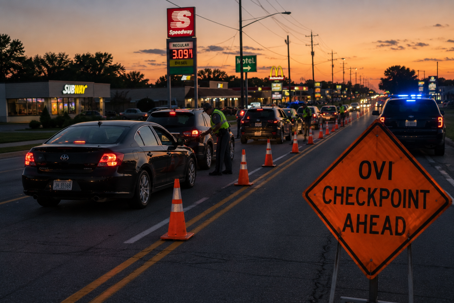
Summer in Ohio means longer days, holiday gatherings, road trips, and a noticeable uptick in OVI (Operating a Vehicle Impaired) enforcement. Between Fourth of July weekend, summer festivals and concerts, and Labor Day travel, law enforcement agencies across the state ramp up patrols and set up more sobriety checkpoints during these months than at almost any other time of year.
If you live in or drive through Ohio this summer, it pays to understand how these checkpoints work, what your rights are if you're stopped, and what to do if you find yourself facing an OVI charge after one. At Horwitz & Horwitz, we've helped many drivers navigate the aftermath of checkpoint stops, and the single biggest factor in outcomes is often how well a driver understood their rights in the moment.
Here's what you need to know.
Are OVI Checkpoints Legal in Ohio?
Yes. OVI checkpoints, sometimes called sobriety checkpoints or DUI checkpoints, are legal in Ohio. The U.S. Supreme Court settled the constitutional question in Michigan Dept. of State Police v. Sitz (1990), ruling that the public safety benefits of properly conducted checkpoints outweigh the minor intrusion on Fourth Amendment rights.
That said, "properly conducted" is the operative phrase. Ohio law requires checkpoints to follow strict procedural rules, and the Ohio State Highway Patrol's own policy on sobriety checkpoints (OSP-200.21) lays out specific requirements. When a checkpoint fails to meet those requirements, evidence gathered there may be challenged in court.
How Ohio OVI Checkpoints Work
To be considered constitutional in Ohio, an OVI checkpoint must meet several core requirements:
Advance Public Notice
Law enforcement must announce the checkpoint to the public before it happens. In practice, the Ohio State Highway Patrol and partner agencies typically issue media notices days ahead of a checkpoint, followed by additional reminders the day before and the morning of the operation. Notices generally include the date, time window, and general location.
This requirement is what allows informed drivers to plan an alternate route if they choose to.
A Neutral Pattern for Stopping Vehicles
Officers cannot single out drivers based on a hunch. Checkpoints must use a pre-determined pattern, such as stopping every third or fifth vehicle, to remove individual officer discretion from the process. This is meant to prevent profiling and arbitrary enforcement.
Visible Signage and a Safe Location
Checkpoints must be visible from a distance, well-lit at night, and clearly marked so drivers know they're approaching a law enforcement stop and not a construction zone or accident. The location itself must be chosen for safety, usually in areas with documented histories of impaired driving incidents.
A Brief, Minimally Intrusive Stop
For drivers who show no signs of impairment, the stop should last only as long as it takes to greet the driver and request a license, registration, and proof of insurance. If officers detect signs of impairment, such as the smell of alcohol, slurred speech, or bloodshot eyes, they may direct the driver to a secondary area for further investigation. Beyond that point, officers need individualized reasonable suspicion to detain a driver further.
Why You'll See More Checkpoints This Summer
Sobriety checkpoints aren't deployed randomly throughout the year. Law enforcement concentrates them around times when impaired driving rates climb. According to the National Highway Traffic Safety Administration, summer holiday periods consistently rank among the deadliest times of year for alcohol-related crashes nationwide.
In Ohio, that translates to heavier checkpoint presence during:
- The Fourth of July weekend
- Summer festivals, fairs, and concert events
- Late-night weekend hours throughout July and August
- The Labor Day holiday weekend
If you plan to drive on or near these dates, expect to see active enforcement. The Ohio State Highway Patrol also maintains a public list of upcoming and recent checkpoints, which is worth a quick search before you head out.
Your Rights at an Ohio OVI Checkpoint
Being stopped at a checkpoint is uncomfortable even when you've done nothing wrong. Knowing your rights ahead of time helps you respond calmly and avoid mistakes that can complicate a case later.
You Must Provide Basic Documents
Ohio law requires you to provide your driver's license, vehicle registration, and proof of insurance when an officer asks. Refusing to hand these over can lead to additional charges.
You Are Not Required to Answer Questions About Drinking
You do not have to tell an officer where you've been, where you're going, or whether you've consumed alcohol. The Fifth Amendment protects you from self-incrimination, and you can politely decline to answer by saying something like, "I'd prefer not to answer that question."
This matters more than most drivers realize. Even innocent statements made at the roadside can be taken out of context and used against you later.
You Can Refuse a Portable (Roadside) Breath Test
A portable breath test, sometimes called a preliminary breath test, given at the roadside can generally be refused in Ohio without administrative penalty. However, declining a chemical test at the station after an arrest triggers Ohio's implied consent law and results in an automatic administrative license suspension. Refusing the station test means a one-year license suspension and a reinstatement fee, rather than the shorter suspension that follows a failed test.
This is a complex tradeoff, and the right choice depends on the specifics of your situation. Speaking with an experienced OVI defense attorney about your options before you're ever in that position is the best way to feel prepared.
You Can Refuse Field Sobriety Tests
Field sobriety tests, such as the walk-and-turn or one-leg stand, are voluntary in Ohio. There is no direct administrative penalty for refusing them. That said, refusing can still factor into an officer's decision to make an arrest based on other observations.
You Can Decline Vehicle Searches
Officers cannot search your vehicle at a checkpoint without probable cause, consent, or another lawful exception. You have the right to decline a search request.
Can You Legally Avoid an OVI Checkpoint?
This is one of the most common questions Ohio drivers ask, and the answer is: yes, but how you do it matters.
If you see an OVI checkpoint ahead and want to avoid it, you can legally take an alternate route. The advance notice requirement was put in place specifically to give drivers that option. The maneuver you make to avoid the checkpoint, however, has to be a legal one.
Examples of legal avoidance:
- Taking a side street that branches off before the checkpoint zone
- Making a legal turn at an intersection
- Choosing not to drive that route at all once you know about the checkpoint in advance
Examples of illegal avoidance that can get you stopped:
- Making an illegal U-turn
- Crossing a double yellow line
- Driving on the shoulder
- Speeding away from the checkpoint zone
- Any erratic or unsafe driving behavior
If you commit a traffic violation while trying to avoid a checkpoint, that violation itself gives officers reasonable suspicion or probable cause to pull you over, and the original checkpoint is no longer the issue.
What to Do If You're Stopped or Charged
If you find yourself going through an OVI checkpoint, the goal is to stay calm, be courteous, and protect your rights without escalating the situation.
A few practical reminders:
- Keep your hands visible and have your documents ready
- Speak respectfully, even if you choose to invoke your right to silence
- Step out of the vehicle only if directed to do so
- Do not argue with officers at the scene; any disagreement is something your attorney can address later
If you are arrested and charged with OVI following a checkpoint stop, the most important step is to stop talking and get legal advice. Even cases that feel hopeless at the roadside can have meaningful defenses, particularly when checkpoint procedures weren't followed correctly. An experienced attorney can review whether advance notice was properly given, whether the stop pattern was truly neutral, whether the signage and location met legal requirements, and whether your secondary screening met constitutional standards. Any failure on the part of law enforcement can become grounds to challenge the evidence in your case.
Talk to Horwitz & Horwitz About Your OVI Case
A checkpoint arrest can feel like the outcome is already decided. It isn't. The procedural requirements for OVI checkpoints exist precisely because the Constitution protects you from arbitrary or sloppy enforcement, and an experienced defense attorney knows how to hold the state to those standards.
At Horwitz & Horwitz, our attorneys handle every OVI case personally, from the first phone call through resolution. We'll go through the details of your stop, examine the evidence, and build a defense strategy tailored to the facts of your case. Call us at (937) 828-5534 or reach out online for a free consultation. The sooner we talk, the more we can do.